ENTERING A NEW NUCLEAR PARADIGM!
These are exciting times for those in and around nuclear. We’re finally seeing progress in advancing the critical regulatory paradigms that have long slowed approvals and unnecessarily burdened nuclear with excess costs. While some of these important updates are starting to roll out, there are quite a few more still in process and, together, they pressage a whole new era of progress for advanced nuclear. We are pleased to highlight the actions that start to level the playing field for nuclear.
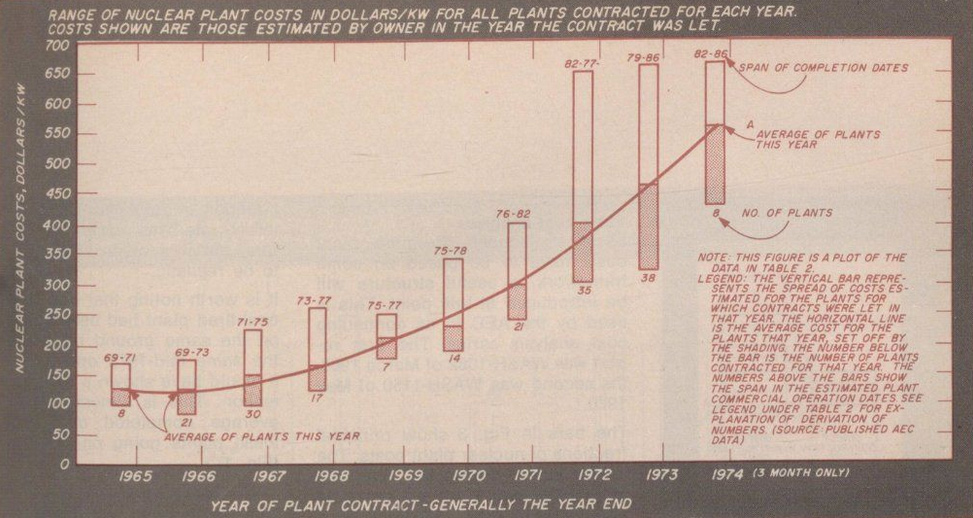
IMPROVING NUCLEAR’S TRAJECTORY
SUMMARY
Nuclear power has the potential to be the (clean) energy the world needs but it can’t do that burdened with senseless, non-beneficial regulatory costs and delays, while also not being valued for having low-carbon, reliable, grid stabilizing and non-volatile priced energy. Global energy markets are some of the most competitive in the world but the fact that fossil fuels command ~80% of global energy is a function of nuclear power having been increasingly disadvantaged by antinuclear biases and over-regulation. Fossil fuels, arguably the most lethal and environmentally damaging energy ever developed, have benefitted tremendously from the old regulatory paradigms—which still do not require these damaging fuels to pay for their dire health or environmental impacts. Increasingly, the federal government, the NRC and the DOE have come to agree. Reforms required by NEICA, NEIMA and the ADVANCE Act, all of which mandated modernization of the regulatory pathway towards the goal of accelerating deployment of new reactors, are finally changing the old regulatory paradigm. Here are some of the top reforms arriving.
TOP NUCLEAR REFORMS
- Introduction of a “Risk Informed” Licensing Pathway. On March 25th, the NRC announced that the Commission had approved the staff’s recommended final rule to add Part 53 to 10 CFR. This new rule, initially directed by the Nuclear Energy Innovation and Modernization Act (NEIMA) of 2019, provides for a technology-inclusive, risk informed pathway for regulatory review of advanced nuclear reactors. The rule is a considerable improvement to the regulatory process that forced advanced nuclear designers to have to address risks specific to light water reactors. It embraces the state-of-the-art approach to risk assessments: risk-informed, performance-based (RIPB) analyses, reduced fees and other extremely important features. The new rule does not require developers to request specific exemptions to rules tailored to conventional light water reactors and not relevant to Gen IV designs. This rule will be published in the Federal Register on April 1st and be in effect within 30 days. Word has it that there are dozens of companies gearing up to submit applications for Part 53 reviews.
- NRC Begins Embracing their New Mission. The NRC’s new Mission Statement, approved in January, 2025, assigns the agency the responsibility for effectively overseeing nuclear energy development for contributions to both environmental protection and national energy security. For too long, the NRC acted as though their only job was to reduce the risk of the use of nuclear power—which essentially prevented new builds from happening. This opened the floodgates for fossil fuel expansion, vastly increasing mortalities from toxic emissions, industry accidents and extreme weather events—well beyond levels that could remotely result from any nuclear accident. Finally, the NRC has been returned to its true mission by the ADVANCE Act, signed by President Biden, recognizing nuclear’s massive benefits as an energy source for America’s health, safety, energy security and national security, and refocusing it on the business of overseeing safe deployments.
- Collaboration to Accelerate Development. Though the DOE and the NRC remain independent agencies with separate missions, they are cooperating as part of Team USA to enable the deployment of new nuclear power. NRC Chairman Ho Nieh described the DOE’s evolution into an “enabling partner.” which can utilize its own authority to allow developers to build and test safely, enabling developers to obtain the very basic test data that is required for them to be able to begin their licensing process with the NRC. This provides a way to get around the “Catch 22” of the lack of an NRC license to build the test reactor which is the best way to get the operating data to prove the safety case, the importance of which to unlocking new nuclear development and deployment cannot be overemphasized.
- Piloting Reactor Programs. In August 2025, the DOE announced its first selections for the brand new Reactor Pilot Program, designed to provide developers with special DOE support for expedited reactor build and test activity, with a goal of getting at least three new reactors to start up in test mode by July 4th, 2026. Since then, several additional developers have joined the program and the Trump Administration, having piloted a pilot program, is now converting it into a permanent program, the Nuclear Energy Launch Pad, to provide ongoing support for demonstration and testing at the Idaho National Laboratory and other DOE and non-DOE sites. This will enable many more companies to accelerate their development activities beyond July 4th.
- Funding for Fuel and Exploring Lifecycle Campuses. The DOE announced three grants for domestic enrichment facilities, each $900 M for a total of $2.7 B. This is part of an urgent effort to support rebuilding lost fuel production capabilities. Importantly, the DOE further recognizes that the U.S. needs to be better at all aspects of the fuel cycle and, in January, issued a Request for Information (RFI) inviting states to express interest in and requirements for hosting Nuclear Innovation Lifecycle Campuses (NLICs). These campuses would potentially support conversion, enrichment, deconversion, fuel fabrication, waste recycling and final disposal activies, as well as new power plants, data centers and other supply chain facilities. The responses to this RFI will help the government figure out next steps towards what may well turn out to be the U.S. joining France, Russia and Japan in having a closed fuel cycle, so we not just store spent fuel but also reprocess and reuse it.
- Moving away from ALARA and LNT. Until now, nuclear regulators assumed that every gamma ray of radiation harmed human health based on the linear non-threshold (LNT) radiation model. Licensees were required to keep doses As Low As Reasonably Achievable (ALARA) with “reasonable” often being interpreted as something approaching “cost is no object.” The effect of ALARA was that the industry was required to spend billions to protect the public from dose exposures less than what you might get from eating a banana. (Explains why pronuclear activists tend to give out bananas at events.) Executive Order 14300, issued in May 2025, directed the NRC to reconsider the LNT radiation protection model and the ALARA requirement. In January 2026, Energy Secretary Wright issued a memo ending ALARA and ordering its elimination from DOE directives and regulations. The DOE is now replacing ALARA with scientifically-guided dose limits based on more up-to-date science that recognizes naturally-occuring radiation levels of various kinds that have no measurable health impacts. The NRC recently began circulating a policy proposal internally that would also replace ALARA requirements with dose limits.
- Improved Environmental Review Protocols. Experience has shown that some licensing and regulatory actions have no significant effect on the environment. But even those actions have traditionally required the production and review of environmental assessments or environmental impact statements. On March 25, the NRC approved a final rule that enables categorical exclusions and eliminates the need to prepare unnecessary, repetitive documentation of the lack of significant environmental harm. Historically, the timeline for environmental reviews has been as long or longer than nuclear safety reviews. These reviews have posed huge burdens on both applicants and regulators. For actions that do not qualify for the categorical exclusion described above, the NRC has developed a pilot program to improve the way that the agency meets the requirements of the National Environmental Policy Act (NEPA). On March 23, 2026, the agency announced that Fermi America would be the first participant in the program, using it during the completion of its combined license application for Project Matador near Amarillo, Texas.
- Project Approvals that take less time, rather than more. On March 9th, the Nuclear Regulatory Commission (NRC) approved TerraPower’s construction permit for its Natrium reactor in Kemmerer, Wyoming. Not only was this the first time since the Plant Vogtle authorization in 2012 that a construction permit was issued, it was the first construction permit ever issued by the NRC for a commercial non-light water reactor. The permit was also issued in 18 months, rather than the 27 months that the NRC had budgeted for its review. According to Adam Stein, Director of Nuclear Energy Innovation for the Breakthrough Institute, the vote from the NRC “marks an important step forward for advanced reactor deployment in the United States. . . . Completing a complex advanced reactor licensing review significantly ahead of schedule reflects improvements in the efficiency of the NRC’s review process while maintaining the agency’s rigorous safety and environmental standards.”
- Streamlining Nuclear Licensing Hearings. The NRC has published rule-making proposals to streamline nuclear licensing hearings by revising procedures for hearings in which project opponents are able to argue against the issuance of a license. Hearings will begin earlier in the process and require participants to provide more information about the basis for their objections, so that these can be more fully considered and, where appropriate, actions taken earlier in the licensing process. The objective is to get to the essence of the objections and be able to wrap up such hearings in 8 to 14 months, rather than allowing them to drag on indefinitely.
- A Framework for Fusion Licenses. The NRC has issued a proposed framework for licensing fusion reactors, as required by NEIMA and the ADVANCE Act, and requested public comment. Much like 10 CFR Part 53, the proposed rules for fusion are technology-inclusive and risk-informed. They deviate from the stricter rules that cover fission reactors and operate more akin to the rules for particle accelerators under a general structure for “fusion machines” that operate to fuse atomic nuclei in order to generate heat and neutrons. In proposing these rules, the NRC is giving fusion developers a glimpse of what their regulatory burdens will be as multiple developers vie to be able to build and test their designs.
In summary, the paradigm for approval and support of advanced nuclear reactors has improved at the federal level beyond our expectations even as recently as late 2025. These are being welcomed by advanced nuclear developers and we believe that we will begin seeing increasing regulatory engagement and faster progress towards building and deploying commercial-scale advanced reactors in the coming years along with growth of a wider array of supply and support services.